
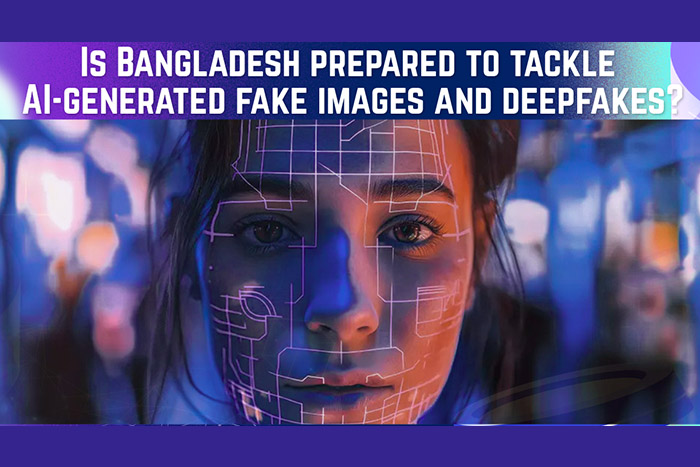
AI-generated deepfakes have become a growing threat in the era of national elections in Bangladesh, as they were employed to propagate political misinformation during the 2024 national poll. In this background, Artificial Intelligence has changed from analyzing information to producing highly realistic images, videos and audio. The surge in creation of ‘deepfakes’ poses serious legal and regulatory issues for Bangladesh. In Bangladesh, the use of such content on social media is increasing, making it harder to tell what is real and what is artificial. The most important question in this context is whether our existing legal framework is ready enough to deal with this new digital reality.
Deepfake technology has the ability not only to distort information but also to create an entirely new artificial reality. The problem here is that people are no longer just confused about the veracity of information, but they begin to believe that content is real that never actually happened. Classical criminal law is based on human behavior and the existence of ‘mens rea’ (criminal intent). But when the harmful material comes from the AI’s, the evidence required to prove criminal intent and liability is much more complex and difficult and poses a challenge to traditional notions of criminal responsibility.
Deepfake’s influence in Bangladesh spans multiple levels. At the personal level it can lead to defamation, blackmail and social disgrace. Deepfakes can also influence public opinion at the political level by disseminating false information. They also disproportionately target women through non-consensual intimate imagery and reputational harm as per a 2025 study conducted on Bangladeshi women. Creating non-consensual fake photos or videos can be a serious form of digital violence, especially for women. In addition, financial fraud and erosion of public trust in state institutions and the media also pose a major long-term risk.
The rapid spread of deep fakes worldwide has been reflected in various studies. A 2024 report by identity verification firm Sumsub found a 245% year-on-year increase in detected deepfakes in Q1 2024, with a fourfold increase over the full year 2023–2024, highlighting the rapid growth of AI-enabled fraud. Similarly, the World Economic Forum (WEF) has identified AI-powered disinformation as a global risk. UNESCO has also warned that generative AI has made it unprecedentedly easy to create misleading content. As a result, deepfakes have become not just a technical but also a significant legal and policy challenge.
In Bangladesh Cyber Security Act 2026, Penal Code 1860 and Pornography Control Act 2012 can be used to deal with deepfake-related crimes in some cases. For example, matters related to defamation, fraud or obscene content can be brought under this law. However, these laws are mainly made considering the reality of the earlier era of AI technology. They control the ‘‘content outcomes’’ but are not designed to control the “content creation process”, which is a major limitation. The most important problem is that there is no clear legal definition of deepfake or synthetic media in Bangladesh. Due to this definitional deficiency, similar offenses may be interpreted differently under different laws. This creates inconsistencies in the judicial process and increases uncertainty in the application of the law. This missing framework of law is not only a technical weakness, but also a doctrinal gap, which may affect the functioning of the judiciary in the future.
The biggest challenge in deepfake cases is establishing evidence. Visual analysis alone is not enough to determine whether a piece of content is genuine or fake. This requires digital forensics, metadata analysis and AI model-level tracing capabilities. As this technical capability is limited in Bangladesh, the presentation of evidence in court becomes complicated. As a result, determining the truth in the judicial process poses a major challenge. Content spreads extremely fast in the digital age, but the legal system cannot keep up with that speed. This creates a “speed gap”, where it becomes difficult to control damage before it occurs. Criminals often use foreign servers, anonymous networks and various platforms to hide their identity, which complicates investigations and law enforcement.
Currently, social media platforms mainly regulate content based on their own policies. There is no strong framework for mandatory quick takedown or algorithmic liability in Bangladesh. As a result, harmful content often spreads widely before legal action is taken and creates social harm. This situation clearly highlights the limitations of platform-dependent control systems.
The world is now seeing a clear shift in the regulation of AI. The European Union has enacted risk-based AI legislation, which imposes stricter controls on the use of high-risk AI. Different states in the United States have adopted different laws to regulate election deepfakes and non-compliant synthetic content. This trend indicates that general cyber laws are no longer sufficient, but rather AI-specific laws are needed.
At present, Bangladesh is partially prepared, but only in a limited sense. While the legal framework provides some protection, it is not technology specific. There is a lack of institutional capacity, particularly in digital forensics and rapid response systems. As a result, the entire system is still reactive, with problems occurring after they arise, rather than preventing them in advance.
A concerted reform is needed to tackle deep-fakes. First, it is important to include clear definitions of deep-fake and synthetic media in the law. Second, AI-specific crime frameworks need to be created. Third, mandatory accountability and swift content removal mechanisms should be introduced for social media platforms. In addition, development of digital forensic capabilities and technical knowledge of judiciary is essential.
The deepfake problem is not primarily a technology problem, but rather an institutional adaptation crisis. Existing laws in Bangladesh offer some protection but are unable to keep pace with the rapidly changing generative AI technology. The key challenge in the future will not be to control the technology but to ensure the dynamism of law and institutional capacity so that the law can evolve in tandem with digital reality.
Surja Mandal is an LL.B. student at the World University of Bangladesh.