
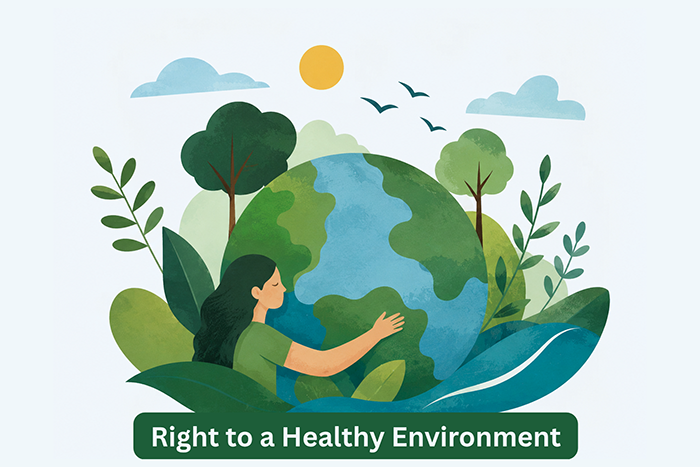
Article 18A of the Constitution of the People’s Republic of Bangladesh declares that the State shall endeavor to protect and improve the environment and to preserve and safeguard natural resources, biodiversity, wetlands, forests and wildlife for present and future citizens. This provision places a constitutional obligation on the State to take necessary administrative and legislative measures to ensure environmental protection.
The inclusion of Article 18A through the Fifteenth Amendment to the Constitution in 2011 was also intended to help Bangladesh fulfil its international commitments under various environmental conventions such as the Convention on Biological Diversity and the UN Framework Convention on Climate Change. This objective is further reinforced by Article 25 of the Constitution, which directs the State to respect international law and the principles enunciated in the United Nations Charter. However, Article 8 of the Constitution makes it clear that these fundamental principles of state policy are not judicially enforceable. As a result, the constitutional duty to protect the environment remains largely aspirational, leaving environmental protection at risk.
The principal statutory instruments governing environmental protection in Bangladesh include the Bangladesh Environment Conservation Act 1995, the Environment Conservation Rules 1997, the Environment Court Act 2010, and the Bangladesh Water Act 2013. However, under the Environment Court Act 2010, only the Department of Environment (DoE) may initiate proceedings; citizens cannot file environmental cases directly. As a result, the enforcement mechanism is largely ineffective, limiting public access to environmental justice.
To ensure genuine environmental protection, the right to a healthy environment should now be recognised as a justiciable fundamental right. The environment is inherently linked to the right to life, which is already guaranteed under Article 32 of the Constitution in Farooque v. Government of Bangladesh. Several national and international courts have recognised that the right to life cannot be fully enjoyed without a safe and healthy environment.
In the landmark case of Dr. Mohiuddin Farooque v. Bangladesh and Others ((1996) 17 BLD (AD), the Appellate Division of the Supreme Court of Bangladesh held that without protection and preservation of the environment, ecological balance, and freedom from pollution, the right to life loses its meaning. Similarly, in India, the Supreme Court in Subhash Kumar v. State of Bihar (1991) and M.C. Mehta v. Union of India (1987) interpreted Article 21 (Right to Life) of the Indian Constitution to include the right to a healthy environment.
The UN Human Rights Committee, in its General Comment No. 36 on Article 6 of the International Covenant on Civil and Political Rights (ICCPR), has also affirmed that the duty to protect life obliges States to address general conditions that threaten life, including environmental degradation. Therefore, protection of the environment is not merely an ecological issue, it is a human rights obligation.
Whenever environmental issues arise, courts in Bangladesh often rely on the right to life as an ‘umbrella’ provision to provide protection. However, as it is now a well-accepted principle recognised by the UN General Assembly in 2022 that a healthy environment is essential for the enjoyment of life itself. It is time for Bangladesh to explicitly recognise the right to a clean and healthy environment as a separate, justiciable fundamental right, rather than leaving it dependent on judicial interpretation.
The Constitution Reform Commission has discussed many areas of constitutional reform, yet it has not given due consideration to this pressing issue. Other nations have already taken progressive steps. For instance, Article 30 of the Constitution of Nepal (2015) guarantees every citizen the right to live in a clean and healthy environment and grants victims the right to compensation. Similarly, Article 24 of the Constitution of the Republic of South Africa (1996) affirms that everyone has the right to an environment that is not harmful to their health or well-being.
If countries like Nepal and South Africa can enshrine environmental rights as fundamental, Bangladesh should also take the necessary step to do the same. Recognising the right to a healthy environment as a fundamental right would not only strengthen environmental governance but also uphold the dignity, health, and future of every citizen. The time for aspirational principles is over; the time for enforceable rights is now.
Md. Tanvir Mahtab is a Lecturer at the Department of Law, Eastern University, and Sadia Shultana is currently working as a Research Associate at Law Bridge.