
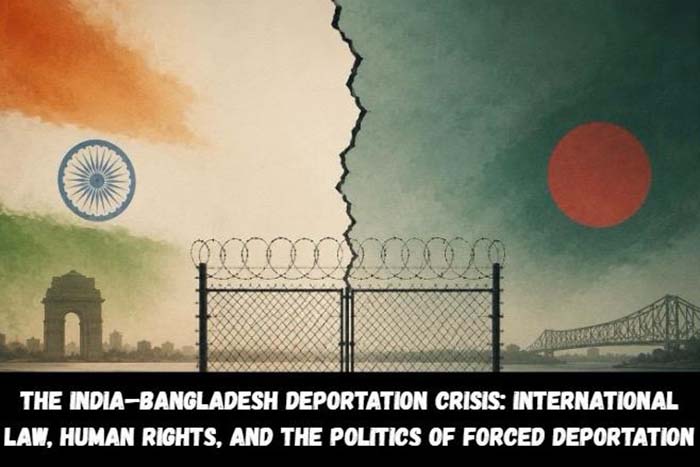
Introduction
“Brother, my son is desperately thirsty. Could you please bring me a bottle of water? I’ll pay for it. Otherwise, he’ll have to drink this rotten water,” pleaded Shamsul Alam, a Bangla-speaking Muslim man who was forcibly pushed across the border by the Indian Border Security Force (BSF). Clutched in his arms was his young son, Abdus Salam. His face was dry, his voice weakened by thirst and repeated cries for water. This is not just the story of Shamsul Alam, but Hundreds of people who are currently stranded inhumanely at the zero point on the Bangladesh-India border.
Hundreds of people have queued up near West Bengal’s border crossings with Bangladesh in recent days, trapped in a human crisis sparked by a newly formed West Bengal state government-led crackdown on undocumented immigrants. Agence France-Presse (AFP) on May 29 reported that it was part of the Bharatiya Janata Party (BJP)’s election campaign to “detect, delete and deport” illegal migrants in Assam and West Bengal. BJP won in both states. Suvendu Adhikari, the Chief Minister of West Bengal, built his election campaign around the matter of what he termed “Muslim foreigners” and “Bangladeshi infiltrators”. Since the BJP came to power in West Bengal on June 4, a massive and coordinated campaign has been underway to detain and covertly deport individuals suspected of being undocumented Bangladeshi immigrants.
In 2025, the Border Security Force (BSF) has not only killed Bangladeshi civilians but has also engaged in illegal abductions and forced “push-ins” of Bengali-speaking Muslims, many of them verified Indian citizens without recourse to any due legal process. The 4,096-kilometre border has now become a theatre of violence, marked by systematic violation of human rights that blatantly vitiate bilateral agreements and international law.
Earlier, in the middle of 2025, India had also carried out a large-scale push in. As per the Prothom Alo Report, between May 2025 and January 2026, India reportedly pushed in 2,479 Bengali-speaking Muslims, alleging illegal entry without presenting substantial evidence. Many of those who were deported strongly insist they are Indian citizens who have lived in the country for years. Such practices represent a systematic dehumanization of Muslim communities, particularly those of Bengali ethnicity, and threaten to ignite a grave humanitarian crisis along the borderlands. Bangladesh has long protested such operations as violations of sovereignty. State Minister for Foreign Affairs Shama Obaed said Bangladesh will strongly resist any attempts of push-ins of unverified Bangladeshis by India. Push-ins go against the international laws as well as the India-Bangladesh treaty on border management. Moreover, this brutal behavior is a direct violation of the well-recognized legal principle pacta sunt servanda state under Article 26 of the Vienna Convention on the Law of Treaties which obligates India to perform its bi lateral treaty obligation.
India’s current push-in operations reflect earlier practices, most notably the 1992 “Operation Push Back,” which resulted in deportation of 132 individuals and drew international condemnation. This kind of push-ins by India was also observed around 2002-2003, when the BJP-led National Democratic Alliance (NDA) was in power. Yet today’s expulsions are without precedent in both scale and frequency. The impact of this violence extends far beyond the immediate fatalities. Families are left to grieve in trauma, livelihoods are shattered, and an atmosphere of fear has come to define everyday life in border communities.
How India’s “Push-In” Operations at the Border Violate International Law
The unlawful detention and “push-in” operations by the BSF at the border amount to prima facie infringements of International Human Rights Law (IHRL). According to Article 9 of the International Covenant on Civil and Political Rights (ICCPR), everyone has the right to liberty and security. No one shall be subjected to arbitrary arrest or detention. No one shall be deprived of his liberty except on such grounds and in accordance with such procedure as are established by law. BSF has been expelling Bangla-speaking individuals, verified Indian citizens, and refugees without verification, legal recourse, or procedural safeguards. Such collective expulsions contravene well-established international norms, codified in Article 13 of the International Covenant on Civil and Political Rights (ICCPR) and Article 22(1) of the International Convention on the Protection of the Rights of All Migrant Workers and Members of Their Families. These provisions mandate individual assessment, adherence to agreed repatriation procedures, and access to judicial review standards India is disregarding. Along with this, as discussed earlier, illegal deportation also violates the principle of pacta sunt servanda state under Article 26 of the Vienna Convention on the Law of Treaties.
These actions also violate the principle of non-refoulement, a cornerstone of refugee protection under customary international law and Article 33 of the 1951 Convention relating to the Status of Refugees and also breach the right to seek asylum under Article 14 of the Universal Declaration of Human Rights (UDHR) in case of any Bangladeshi citizen asking for refugee status or asylum. The BSF’s long-criticised “shoot-on-sight” policy also raises concern. International law permits lethal force at borders only when absolutely necessary to protect human life. Along with this, this policy directly violates Article 6 of the ICCPR, the right to life is non-derogable, while Article 7 of the ICCPR and Articles 1 and 16 of the Convention against Torture (CAT) strictly prohibit torture, cruel treatment, and inhuman punishment. Reports of torture, killings, and other inhuman acts by the BSF clearly violate these core protections. They also undermine the fundamental guarantees of liberty and personal security protected under Article 9 of the ICCPR. The United Nations Human Rights Committee has interpreted these provisions to extend protections not only to legal citizens but also to long-term residents who may lack documentation. It is to be noted that, both Bangladesh and India are parties to the ICCPR and thus legally bound by its terms.
Violation of Bilateral Agreement
Bangladesh and India have formal agreements to manage border issues cooperatively. These include the 1975 Joint India-Bangladesh Guidelines for Border Authorities of the two countries and the 2011 Coordinated Border Management Plan (CBMP). Through dialogue under these protocols, it is possible to resolve all kinds of border problems, including human trafficking and undocumented migration. For example, the CBMP has designated responsible officers (Nodal Officers) from India’s BSF and Bangladesh’s BGB to resolve issues such as illegal infiltration and human trafficking. Their job is to take the initiative to resolve any disputes regarding border management peacefully through dialogue and, if necessary, to inform higher authorities. Unilateral actions like mass push-ins, therefore, violate these standing agreements. They undermine trust and erode the institutional mechanisms that were built over decades to handle precisely these sorts of situations. Thus, India is clearly violating numerous international laws, customs, and conventions by pushing Bangla-speaking Muslim people, who have been living in that country for a long time.
What the Bangladesh Government Needs to Do
The systematic reliance on illegal push-ins, combined with extrajudicial killings and the denial of due process, signals a profound collapse of justice at the India–Bangladesh frontier. These practices not only trample upon individual rights but also destabilise entire communities, rendering them stateless, displaced, and defenceless. The Bangladesh government must act with resolve. While diplomatic channels should remain open, the issue must also be internationalised. The UN and relevant international bodies should be engaged to mediate and document these violations. What is urgently needed is decisive action to hold India accountable for its border conduct, including reported extrajudicial killings of Bangladeshi civilians and the unlawful removal of Bengali-speaking Muslims.
The author is an LL.B. student at Jagannath University.