
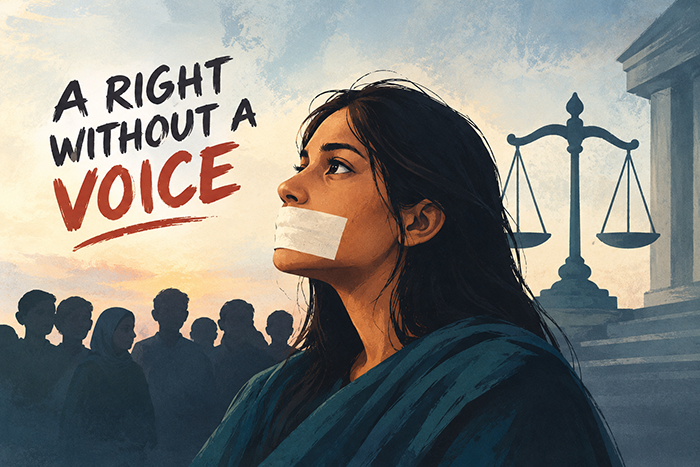
“What is the use of a right if the person who possesses it does not know how to claim it?”
At the edge of a crowded city, a rickshaw puller once asked me something that sounded almost embarrassingly simple: “ভাই, আইন কি আমাদের জন্যও?” Brother, is the law for people like us too?
I did not know how to answer him.
Not because the law is silent. Our Constitution speaks. Statutes speak. Courts speak. The shelves are full of solemn words: justice, equality, liberty, and dignity. But somewhere between those pages and the pavement, the voice of the law grows faint. We have rights written in beautiful language, yet too many people experience them as promises made to someone else.
A right printed in a Constitution is powerful, but on paper only. For a poor worker who cannot afford legal help, for a woman whose complaint is waved away as a “family matter,” for a child who does not know whom to ask, or for anyone facing an intimidating institution alone, that same right can feel like a locked door. The key exists. Nobody told them where to find it.
Our Constitution guarantees equality before the law and recognizes fundamental freedoms. These are not decorative sentences. They are commitments made to every citizen. The rule of law means that power answers to law, not that law sits in a book looking dignified. But justice is more than the existence of rules. Justice begins the moment an ordinary person can actually reach it.
Picture two citizens facing the same injustice. One knows the law, understands the procedure, and has a lawyer within reach. The other knows only that something wrong has happened. Both hold the same constitutional dignity, yet their ability to defend themselves may be worlds apart.
We tend to measure a legal system by its grand furniture: courtrooms, statutes, and landmark judgments. Perhaps we should ask a smaller question instead. When an ordinary person knocks on the door, is anyone listening? Is the complaint taken seriously? Can they seek help without being overwhelmed by fear, cost, delay, or pressure to let the matter drop?
If the answer is no, our problem is not a shortage of laws. It is the distance between law as a promise and justice as something a person actually experiences. That distance is dangerous. People who meet injustice again and again without remedy eventually stop knocking. When citizens stop believing the law can protect them, the rule of law loses something more precious than authority. It loses trust, which is harder to rebuild than any statute.
There is a way forward, though. Law does not belong exclusively to lawyers, judges, and legislators. It belongs to the people. Legal literacy can turn a frightened citizen into an informed one. Genuine legal aid can turn a locked door into an open one. Institutions that serve their purpose can turn fear into confidence. And young people, through writing, debate, and plain conversation, can carry legal rights out from behind university walls and place them where people can find them.
That is why the pen matters. It can ask questions that are too easily avoided. It can give language to someone who has never had the words for what happened to them. It can remind a society that behind every clause is a person with a name, a family, and a claim to dignity that does not expire because they could not afford a lawyer.
Beautiful words about justice are not worth much if we refuse to carry them into the lives of the people for whom they were written. What we need is a justice system where the law is not merely written for citizens but reachable by them.
So if that rickshaw puller asked me the same question today, I would answer differently.
Yes. The law is yours. Your dignity is yours. Your rights are yours. Our task is to make sure they do not stay trapped inside a book.
A right without a voice is fragile. A right without access is unfinished. A right without justice is only a promise, still waiting for someone to keep it.
Let the law leave the page. Let justice reach the street. Let every citizen know not only that they have rights, but that their voice counts.
The author is a student in the Department of Law at National University, Bangladesh. The write-up reflects the author’s own views and opinions.