
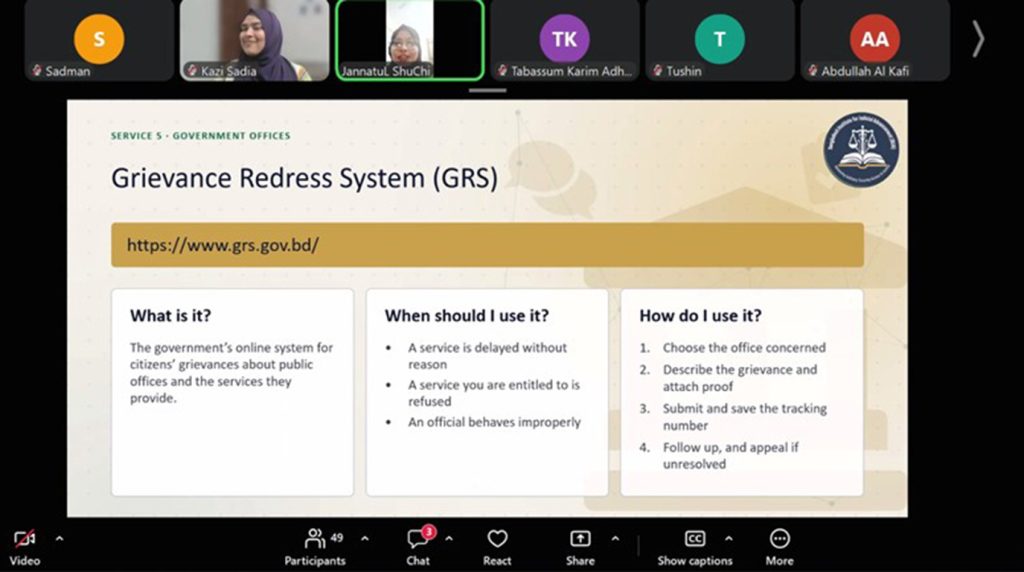
BIJA successfully conducted a virtual Training of Trainers (TOT) session on Zoom titled “Access to Digital Justice, Rights, and Safety.” The session aimed to help participants understand how digital platforms can make justice more accessible, affordable, and safe, and to prepare them to share this knowledge within their own communities. It brought together 50+ participants, including students of law, technology, and related fields from various universities such as Brac University, Stamford University, East University, North South University, University of Information Technology and Sciences, World University of Bangladesh, and others.
The session was conducted by Kazi Sadia Akter and Jannatul Alam Suchi, and facilitated by Surja Mandal and Sadman Bin Islam Prangon. It began with a round of introductions, in which participants shared their backgrounds and interests in law and digital justice, after which the conductors explained the concept of digital justice as the ability to access legal services and remedies through digital platforms without always visiting a court or judicial body. Participants discussed its key benefits, including efficiency, lower costs, transparency, and greater safety for victims who seek help without facing further harm.
Participants received practical guidance on filing a General Diary (GD) online, including document submission, verification, and the importance of valid identification such as a National ID or passport. The session also explained how family-related complaints can be filed through the e-Family Court platform, how legal aid is available for those who cannot afford a lawyer, how the Grievance Redress System handles complaints on matters such as NID issues, property disputes, and pension claims, and how e-Judicial Services, including online cause lists, inheritance calculators, and the e-bail bond, reduce the need for physical visits to court.
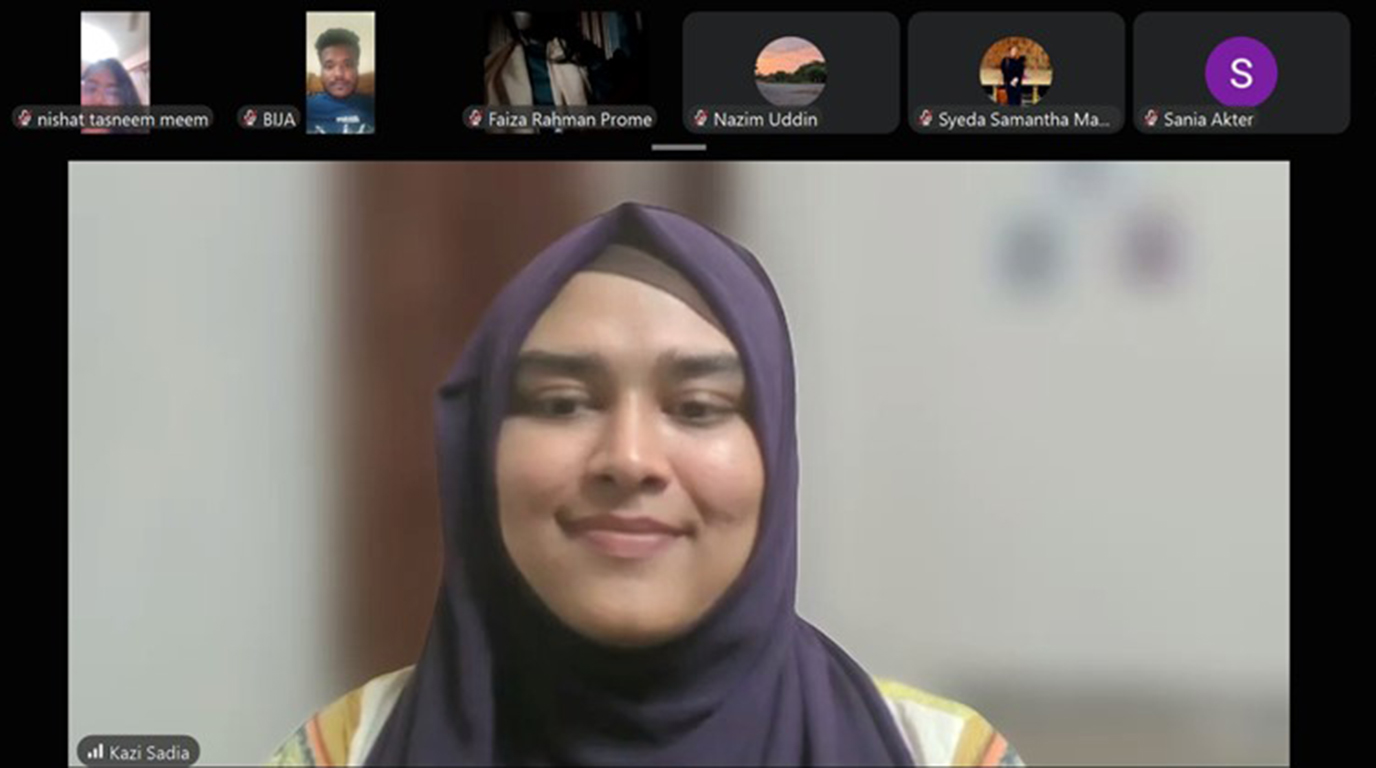
The session further covered cybercrime and cyber safety. Participants were introduced to the evolution of Bangladesh’s legal framework, from the ICT Act to the Digital Security Act and the Cyber Security Act, and to common offences such as online sexual harassment, revenge porn, hacking, and blackmail. They learned how to preserve evidence through screenshots, recordings, and transaction IDs, how to secure their accounts with strong passwords and two-factor authentication, and how to report incidents to police stations, the Cyber Tribunal, or the Cyber Police Center, with the added understanding that penalties are higher for offences against women and children.
Through real-life scenarios such as lost documents, defective products, online threats, post-divorce maintenance, and unprocessed old-age pensions, participants discussed which law and platform applies to each situation and shared their own experiences of filing complaints online and offline.
The session concluded with a reflection in which participants shared their learning outcomes and commitments in the chat. Supporting material, including a PDF on rules and relevant websites, will be shared through the WhatsApp group, and participants were encouraged to explore platforms such as DNCRP, e-Family Court, and e-Judicial Service.
Overall, the session strengthened participants’ awareness of digital justice services, deepened their understanding of legal rights and cyber safety, and encouraged responsible and informed engagement with Bangladesh’s evolving digital justice system.